
Confused Between MBBS in India and MBBS Abroad?
After NEET 2026, one of the biggest dilemmas for students and parents is choosing between MBBS in India and MBBS abroad. The confusion is natural because both options come with their own advantages, risks, and long-term impact on your medical career.
Many students make this decision emotionally or based on incomplete information. However, this is not just a college choice, it is a 6-year commitment that directly affects your career, finances, and future opportunities. The right approach is to compare both options based on facts, not assumptions.
MBBS in India – High Competition, Limited Seats
MBBS in India is considered the most preferred option, but it is also the most competitive. Every year, lakhs of students compete for a limited number of government medical seats. Even a small difference in NEET score can decide whether you get admission or not.
Government colleges offer affordable education, but the cut-offs are extremely high. Private medical colleges provide another route, but their fees often range between ₹60 lakhs to over ₹1 crore. For many families, this creates a serious financial burden, making the decision more complex.
MBBS Abroad – Growing Choice for Indian Students
MBBS abroad has become a structured and practical option for students who do not secure a government seat in India. Countries like Russia, Uzbekistan, Kazakhstan, and Georgia offer medical education at significantly lower costs compared to private colleges in India.
The admission process for MBBS abroad is straightforward and transparent, without donation or capitation fees. Students also get exposure to international education systems and diverse clinical environments. However, the quality of experience depends heavily on choosing the right university.
Fees Comparison – India vs Abroad
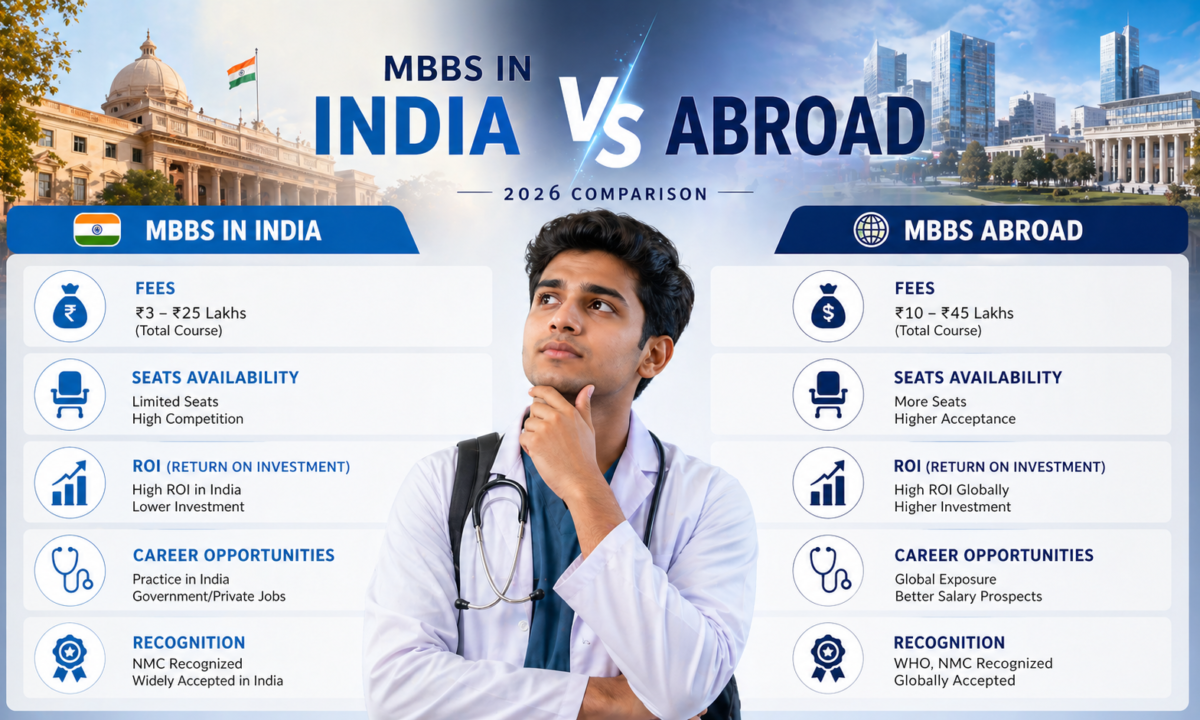
One of the biggest deciding factors between MBBS in India and abroad is the cost. Government MBBS in India is affordable, but extremely difficult to secure. Private MBBS colleges are expensive and can put long-term financial pressure on families.
In comparison, MBBS abroad offers a more balanced cost structure, typically ranging between ₹20-40 lakhs for the entire course. This makes it a viable option for students who want to pursue MBBS without taking on heavy financial stress. However, students must also consider additional expenses like travel and living costs.
Competition and Admission Difficulty
The level of competition in India is significantly higher than abroad. Even students with decent NEET scores often fail to secure a government seat due to the limited number of available colleges. This makes the admission process highly unpredictable.
MBBS abroad offers a more predictable pathway. As long as the student qualifies NEET and meets basic eligibility criteria, admission is generally achievable. This reduces uncertainty and allows students to plan their future more clearly.
Career Scope and FMGE/NExT Factor
Career opportunities after MBBS depend not only on where you study but also on how well you prepare. Students studying in India do not need to clear FMGE, but they will have to appear for NExT in the future. Students who study MBBS abroad must clear FMGE or NExT to practice in India.
This makes it essential for MBBS abroad students to focus on strong academic preparation from the beginning. Choosing a university with good clinical exposure and academic support can significantly improve their chances of clearing licensing exams.
Learning Environment and Exposure
MBBS in India provides strong clinical exposure due to high patient flow, especially in government hospitals. However, infrastructure and facilities can vary depending on the college. The learning experience is often intense and competitive.
MBBS abroad offers a more structured academic environment with modern infrastructure in many universities. Students get exposure to international teaching methods and diverse patient cases. The key factor remains the quality of the university and hospital attached to it.
ROI – Return on Investment Matters
Return on investment is an important factor when comparing MBBS in India vs abroad. Government MBBS in India offers the best ROI due to low fees and strong clinical exposure. However, it is accessible only to a small percentage of students.
Private MBBS in India has a higher financial risk due to its cost. MBBS abroad, on the other hand, offers a balanced ROI if students successfully clear licensing exams and build a stable medical career. The focus should always be on long-term outcomes rather than short-term savings.
Which Option Is Better for You?
There is no universal answer to whether MBBS in India or abroad is better. The right choice depends on your NEET score, budget, career goals, and readiness to adapt. Students with high scores and strong ranks should aim for government colleges in India.
Students who do not secure a government seat but are serious about becoming doctors should consider MBBS abroad as a practical and structured option. The decision should be based on clarity, not comparison with others.
Final Thought – Choose Smart, Not Emotional
The biggest mistake students make is trying to follow a “one-size-fits-all” approach. MBBS in India and MBBS abroad are two different pathways, both leading to the same goal of becoming a doctor.
What matters is choosing the path that aligns with your reality and long-term vision. A well-informed decision today can save years of struggle and confusion later.
Take the Next Step with Clarity
If you are confused between MBBS in India and MBBS abroad, the smartest step is to evaluate your options based on real data and expert guidance. Understanding your position clearly will help you make a confident and correct decision.
It’s not about where you study it’s about how wisely you choose your path.